Showing posts with label AAP. Show all posts

Saturday, May 23, 2015

One Year of Good Governance - Part 1

Background:

When India prepared to go through the 16th General Elections after her independence, it was different than any other general elections held in the past. There was a feeling of restlessness amongst people. Stories of rampant corruption and new scams was an everyday affair. Indian youth was in the depth of despair and it seemed there was no option and no way to stop the rot and bring this great nation to its old glory.  

Courtesy: @manjultoons

This is when the main opposition party, BJP, announced the then Chief Minister of Gujarat, Narendra Modi, as its Prime Ministerial candidate. Modi had won the third consecutive election in Gujarat in December, 2012 and was seen as a development oriented politician by the young electorate. The Congress party was planning to field Rahul Gandhi as its prime ministerial candidate, but, the announcement of BJP to field Narendra Modi as PM candidate baffled Congress. The gaffes of Rahul Gandhi were no match to splendid track record of Narendra Modi as Chief Minister of Gujarat. With every passing day, the battle started intensifying.    

In the meanwhile, the anti corruption movement that came into effect during the UPA-2 tenure, was converted into a political party named as "Aam Aadmi Party". This party, that was apparently formed to fight corruption, started to show the greed for power after winning Delhi Assembly election in December, 2013. Ambitions of the AAP leaders started to float in air and they started visualising themselves as a third alternative after BJP and Congress at the national level. With "traditional"  third front in completed disarray, Indian Media that is invariably looking for dramatic and sensationalized news items, provided them all the coverage they needed to advertise themselves as the third but "most honest" option. With unexpected media support and their heads in the cloud, the Aam Aadmi Party decided to contest the Lok Sabha elections at national level. Majority of news channels that did not like Narendra Modi due to their own prejudices and hidden agendas were quick to declare the AAP as the dark horse who according to them was ready to upset BJP and Narendra Modi's apple cart. The so called poll experts started calling it a three way fight between Congress, BJP and AAP. 


Poll Results:

The voter turnout was the biggest in the history of Indian General Elections with 66.4% of electorate casting their votes to choose their next government. There were myriad number of opinion polls and exit polls on various news channels. Some predicted a hung parliament and some predicted absolute majority for NDA with a slender margin. But when the final results were declared, majority of "political pundits" were completely taken aback by the outcome of election. BJP had won an absolute majority on its own and NDA as a coalition fell a little short of the two third majority mark in Lok Sabha. The People of India had chosen promise of development and good governance over the reigning corruption. Aam Aadmi Party turned out to be a damp squib losing deposit on 96% of seats the party contested.  


Strength of Parties in Lok Sabha


Expectations:

This victory was the first one since 1984 when a single party got the absolute majority in Lok Sabha. In 1984, the stunning majority that Congress party got was influenced by the sympathy wave created by assassination of Mrs Indira Gandhi. On the other hand, the victory of BJP under the leadership of Narendra Modi was indicating presence of a different wave. The wave aimed at changing the 'status quo' in Indian politics. This wave was created by Indian youth that rallied behind Narendra Modi to hand over an unprecedented win to BJP. They had many expectations from the leadership of Narendra Modi.

I expressed my feelings and expectations in the form of a small poetry.
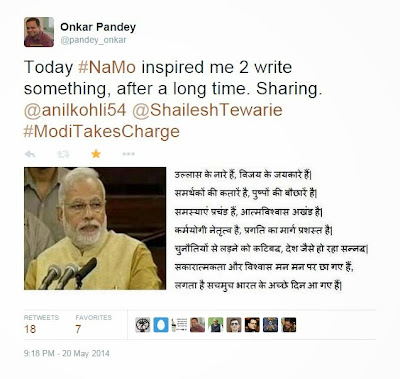


Report Card:

NDA government took oath of office on 26-May-2014 with Narendra Modi sworn in as the 15th Prime Minister of India. A cabinet of ministers took oath in the same ceremony. In his first cabinet meeting chaired by the Prime Minister, the first decision that the cabinet took was to form a Special Investigation Team (SIT), headed by a retired Supreme Court Judge, to probe black money stashed abroad.

Oath of Office

With this decision, the government got cracking to get the economy back on track through various initiatives and schemes. The rot of last 10 years of Congress rule was big and systemic changes were needed to clean it up. However, it looks like the government has got its feet in the door.

The government initiated various programs and schemes that cannot be described in one blog post. 

These initiatives include:
  • Strategic Alignment of (neutral) Neighbours with India
  • Swachh Bharat  and Namami Gange Mission
  • Make In India
  • Formation of NITI Aayog
  • Focus on Policy and Processes
  • Financial Inclusion of poor through Jan Dhan Yojana
  • Social Security for everybody through Atal Pension Yojana and PM Bima Yojana
  • Passing the Black Money bill
  • Coal Block and 2G Spectrum Auction
  • Money Lending for un-organized sector through Mudra Bank
  • Land Acquisition Bill
  • Goods and Services Tax Bill
  • Recognition of India by various World Forums

I will try to do justice with these initiatives by covering them in separate dedicated posts coming soon.

Sunday, May 11, 2014

Pollution in Sabarmati River: What is the truth?


River:
 
Oxford dictionary defines the river to be "A large natural stream of water flowing in a channel to the sea, a lake, or another river". So, when the water ceases to flow, it cannot technically be a river.
 
If a river is dependent mostly on rainwater for its flow, it will cease to be a river when the rainy season is over. I have seen few such rivers in my hometown Nagpur which are reduced to nothing but a nullah once the rains are gone.  

Culprits:
 
So, what makes a river cease to be a river and become a nullah?  Major contributing factors are:
 
  1. Waste (organic and inorganic) dumped into the river by humans.
  2. Industrial waste dumped into the river.
  3. Lack of enough water in the river to keep flowing. If there is ample water, it will dilute the waste and prevent it from becoming a complete nullah.
Looking at these factors, can we say that during most part of the year, Sabarmati river used to be reduced to nullah? Below images will help answer this question:


When the government of Gujarat started working on reviving the Sabarmati river, it was obvious that these causes of pollution will need to be fixed for river to be able to serve the people of state again. But the most important thing needed for making it a "fulltime" river was the enough supply of water to keep it flowing throughout the year. Gujarat government diverted the water from Sadar Sarovar Dam to Sabarmati to keep the river flowing. This was the first major step in cleaning up the Sabarmati river. The government also created the Sabarmati River Front Development Corporation to develop the river banks from commercial and aesthetic point of view. Below images are examples to show the success the government achieved. It is remarkable.


Intercept sewage water and divert it to treatment plant instead of dumping into the river.


Why discuss the Sabarmati now?

Some politically motivated guys who do not wish to bear responsibility, but believe only in firing non-sense allegations and running away without waiting for an answer, raised questions on the pollution levels of Sabarmati river. It was a politically motivated move to gain cheap attention just before the campaigning for last phase of general election was concluded.
 
Also, for some time now, old articles on websites are being circulated to mislead the people about pollution in Sabarmati. Below image shows an example of that. The article in question can be found here. The author of this article has put a note in the comments section about mysterious resurfacing of this old article. We will discuss the findings of this article in the "Facts and Figures" section.


Those responsible for circulating the old articles like the one mentioned above, went ahead and collected samples to carry out the so called analysis of water in Sabarmati to ascertain its quality. They then did a press conference to present the so called findings. The article about this press conference can be found here. They used the TDS (total dissolved solids) count to make the point that the water is badly contaminated.
 
Facts and Figures:
 
TDS is not a conclusive method to determine the quality of water. It only tells you what is the amount of dissolved solids in water. Further tests are needed to confirm what those solids are. Most often, high levels of TDS are caused by the presence of potassium, chlorides and sodium. These ions have little or no short-term effects, but toxic ions (lead arsenic, cadmium, nitrate and others) may also be dissolved in the water. So, a further assessment of dissolved solids is needed to confirm if the water is really bad.
 
I tried to search for some historical data on the pollution of Sabarmati and I found a paper published by R M Bhardwaj. It has a table showing water quality of major Indian rivers and some of their tributaries for the year 2002. I have reproduced that table below and highlighted the findings for Sabarmati. The paper can be found here.


According to this table, the TDS for Sabarmati in 2002 was roughly between 172 Mg/L to 8660 Mg/L. This has been found by converting the "Conductivity" from the table above to "TDS". What the AAP guys have reported in their press conference is that the TDS is 13400 Mg/L. It is worth noting that the water needs to be sampled at different locations and one needs to come out with a range of TDS rather than one big value that suits you.
 
Also, There are few other things we need to consider here. These are:
 
  1. Population surrounding the river in 2014 is way bigger than what was there in 2002.
  2. The industrialization around the river in 2002 was much lesser than what is there in 2014.
 
So, this makes the findings reported by AAP suspicious and of course, inconclusive. It also points to the fact that the efforts made by Gujarat government have been helping to keep the pollution level down. 
 
I took some more effort to compare the other factors that can be used to measure the quality of water. These are BOD and COD. They are defined below.
 
BOD (Biochemical Oxygen Demand) - The amount of oxygen required by micro-organisms to degrade the organic matter. The BOD values depends on the dissolved organic matter in the waste water samples. More the organic matter more the demand of oxygen by microbes to degrade it.

COD (Chemical Oxygen Demand) - Uses a strong chemical agent (such as potassium dichromate) to degrade both the organic as well as inorganic matter present in the samples. COD values are always higher than the BOD values. Because COD includes both biodegradable and non-biodegradable substances whereas BOD contains only bio-degradable.

 
 The article from "Sadia" that I have mentioned above, appeared in March 2012. It derives its findings from a paper for which the link is also given in her comment. This paper presents the BOD value for Sabarmati river at various points. These measures are:


There was one more paper by Nidhi Saxena, S. N. Misra and R. N. Shukla that was published in the Journal of Chemical and Pharmaceutical Research. This paper contains a study of water quality of Sabarmati in 2010. These findings are as below:


The findings of these two papers are pretty much comparable and show values that are generally within the values published in 2002 report.
 
Gujarat government is also working to completely prevent the dump of sewage into the river and thus further reduce the pollution. The article about this work can be found here.
 
Conclusion: 
 
The so called study conducted by AAP on quality of water is inconclusive and does not present authentic proof of deterioration of water quality as compared to what it was in the past. These guys are more known for their "Shoot and Scoot" way of working and their claims do not deserve to be taken seriously. 
 

Sunday, February 16, 2014

रहिमन जिव्हा बावरी...

For last few months, observing various reports in mainstream media and some of the comments on social media reminded me of a couplet that was taught to us in the school days.
  
           रहिमन जिव्हा बावरी कहिगे सरग पताल | 
           आपु तो भीतर रहय जूती खाये कपाल ||

This couplet was written by poet Rahim who was born in the 16th Century AD. Even though this couplet is over 400 years old, it is still relevant in today's world. For readers that do not understand Awadhi (a dialect of Hindi spoken in some parts of Uttar Pradesh), the meaning of this couplet is explained below:

"Tongue speaks bitter words, but, it remains protected inside the mouth. It is the head that has to suffer the beating."

Morale of this couplet is that one should keep his/her tongue under control as uncalled for and profane utterances may land one in trouble. But, many people who are looked at as idols by others do not give much thought to this.

An ardent fan of Aam Aadmi Party had made a comment on twitter that referred to Rahul Gandhi and Narendra Modi as moron and murderer respectively. This comment was retweeted by the then Chief Minister of Delhi, Arvind Kejriwal, inviting criticism from different quarters of the society.
 

This same guy, while singing at a concert organized by the Aam Aadmi Party sang a song with some objectionable words and this was very proudly reported by Rahul Mehra, a senior leader of the Aam Aadmi Party, on twitter.


One of the ministers of Aam Aadmi Party in Delhi, Somnath Bharti, accused media of taking money from Narendra Modi to defame him. The minister had earlier performed a midnight raid against some African women in south Delhi, where according to his belief, a drug and prostitution racket was taking place. When media asked him whether he would resign on moral grounds over the midnight raid issue, he asked media, “How much money has Modiji paid you?”  This was severely criticized by different sections of the society and the minister had to apologise for his comments.
 
While protesting against the Delhi Police for defying law minister Somnath Bharti during the midnight raid, Delhi Chief Minister Arvind Kejriwal called himself an anarchist. He even invited the general public to join a 10 day protest. It is still unclear what he was trying to gain from the protest other than protecting his minister who seemed to be caught on the wrong side of law during the midnight raid.
 
Another incident of reckless comments from Aam Aadmi Party took everyone by surprise. One very senior leader of the party and a Supreme Court lawyer, Prashant Bhushan, landed himself in trouble when he made a comment demanding a plebiscite on presence of Army in Kashmir. He went on to suggest that Kashmir should be allowed to separate itself from India if the result of plebiscite is in favor of separation. His views were in stark contrast to the nation's view on this issue. After his statement, a group of youths stormed into his chamber in the Supreme Court and roughed him up.
 
But, it's not just the political class that is accused of making slanderous statements. Few very senior members of mainstream media also find it titillating to make such statements. Rajdeep Sardesai is the editor in chief of a big media house and is often questioned on the social media for his comments that many feel are biased towards a particular political group. Last week one of his tweets took the twitter by storm.
 

With this tweet, twitter was inundated with comments and angry reactions directed towards Rajdeep Sardesai from people who felt offended by him comparing a mass leader and Chief Minister of a state with his pet. He later tendered an apology through another tweet but at the same time tried to play victim claiming that he was threatened on social media and phone for his earlier tweet.
 
Few of these comments (quoted above) show a feeling of hatred towards the opponents. The young minds easily get influenced by such comments and may get involved in activities that court troubles for them. Some comments further hamper the credibility of mainstream media that is already running low on credibility.
 
The comments made by Prashant Bhushan, however, are far more serious. With his comments, Pakistan has got a chance to raise this issue again. In fact, Pakistan has urged India to look into the demands made by the Aam Aadmi Party and to carry out a plebiscite in Kashmir on whether Kashmir wants to stay with India or not. But above all, his comments have hurt many Indians.


Are all these statements made for personal gains and popularity or just to divert the attention of country from other more important issues? Can the editor in chief of a media house claim to be a neutral observer and reporter after making insulting comments about a mass leader? Is it personal hate or something else that made him make these comments? Is the media house turning a blind eye to this incident good for the credibility of mainstream media? How can the senior leader of a political party that dreams to rule the country be so morbidly insensitive about an issue that runs through the veins of this country? 
 
Only Vishal Dadlani, Somnath Bharti, Arvind Kejriwal, Rajdeep Sardesai and Prashant Bhushan can answer these questions. But, I am sure answering these questions raised by a commoner like me does not make sense to them.